How to Start an Orthopedic Clinic in 2026
Are you planning to start an orthopedic clinic in 2026? From choosing the right location and equipment to managing compliance, staffing, costs, and patient care, here’s what you need to know before opening your practice.
Starting an orthopedic clinic is a major professional decision. It involves more than choosing a room, buying an examination table, and putting up a clinic sign. The practice needs to be clinically appropriate, legally compliant, financially manageable, and convenient for patients.
For an orthopedic surgeon, planning is particularly important because patients may arrive with fractures, joint pain, sports injuries, arthritis, ligament problems, or difficulty walking. The clinic should therefore support proper examination while remaining accessible and comfortable for people with limited mobility.
A practical way to approach the process is to decide what services you will provide first, then plan the location, infrastructure, equipment, staffing and systems around those services.
1. Decide What Kind of Orthopedic Clinic You Want to Start
Before looking at properties or purchasing equipment, define the clinical scope of the practice.
A consultation-based orthopedic clinic has different requirements from a centre that also provides procedures, physiotherapy, imaging or multiple specialties. A new practice does not have to offer every service from the beginning.
Consider:
- General orthopedic consultation or a focused practice
- Joint replacement, sports injuries, trauma or other areas of expertise
- Consultation-only care or selected procedures
- In-house rehabilitation or referral to another centre
- Diagnostic services onsite or through external providers
- Expected patient volume during the first year
Starting with the services that you can provide well and expanding later when there is a genuine clinical need can be more practical than making a large initial investment.
2. Choose a Location Based on Patient Accessibility
The location should be evaluated from the patient’s point of view.
An orthopedic patient may be using a walking stick, crutches, wheelchair or family assistance. Therefore, convenient access can be more important than simply having a highly visible commercial address.
Look for practical features such as:
- Convenient road access
- Parking or patient drop-off space
- Ground-floor access or a functional lift
- Adequate waiting space
- Easy entrance for patients with mobility limitations
- Nearby hospitals, diagnostic centres or rehabilitation services
For an orthopedic clinic in Patna, the decision should also consider the local patient population, rent, accessibility and the type of orthopedic services planned. There is no single location that guarantees a successful practice.
3. Plan the Clinic Around the Patient Journey
A clinic works better when the physical layout follows the way patients actually use it.
A straightforward patient journey might be:
Appointment → Registration → Waiting → Clinical examination → Investigation/referral if needed → Treatment discussion → Documentation → Follow-up
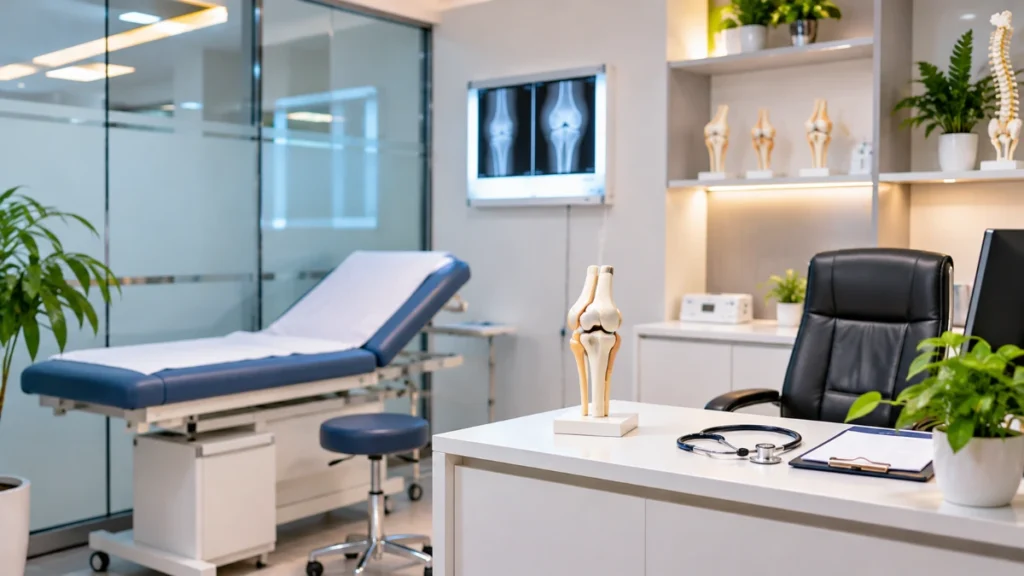
The consultation room should provide sufficient privacy and space for examination. Orthopedic assessment may require observation of walking, checking joint range of motion, comparing both limbs, testing strength, or examining swelling and deformity.
The waiting area should also consider patients who cannot comfortably stand for long periods.
A good clinic does not need an elaborate interior. It needs a layout that allows patients to move through registration, consultation and follow-up without unnecessary confusion.
4. What Equipment Is Needed for an Orthopedic Clinic?
Equipment should be selected according to the services offered rather than purchased simply because it is advanced.
A basic consultation-focused clinic may need:
- Examination couch
- Blood-pressure monitor
- Pulse oximeter
- Weighing scale
- Stethoscope
- Reflex hammer
- Goniometer
- Appropriate orthopedic examination tools
- Basic clinical and dressing supplies where required
There should also be enough practical space for gait and functional assessment.
Digital X-ray, ultrasound, physiotherapy equipment and other advanced systems may be considered when they are clinically justified and financially sustainable. If these services are not initially required, referral arrangements with appropriate facilities may be more practical.
Read More: How to Start a Gastroenterology Clinic in 2026
5. What Registrations and Compliance Should Be Checked?
This is one area where a doctor should not rely on a generic online checklist.
The applicable requirements depend on the state, premises, services and structure of the healthcare establishment. In Bihar, current state rules and applicable local requirements should be checked before the clinic begins operations. The Bihar government has published the Bihar State Clinical Establishments (Registration and Regulation) (Amendment) Rules, 2026.
Professional registration and recognized qualifications are fundamental. The doctor should practice within the scope of their professional training and registration, and appropriate patient records should be maintained.
Biomedical-waste management is another important consideration. Bihar State Pollution Control Board guidance states that healthcare facilities generating or handling biomedical waste, including clinics and clinical establishments, are subject to authorization requirements under the applicable biomedical-waste rules.
Depending on the clinic’s services and premises, requirements may also involve:
- Clinical-establishment registration
- Biomedical-waste authorization
- Local premises or municipal requirements
- Fire and building-safety requirements where applicable
- Drug-related permissions where applicable
- Diagnostic or laboratory permissions where such services are provided
The exact checklist should be confirmed with the relevant Bihar and local authorities before opening.
6. How Many Staff Members Does a New Orthopedic Clinic Need?
A small orthopedic practice does not necessarily need a large team.
A consultation-focused clinic may initially require front-desk support, appropriate clinical assistance and housekeeping. As patient volume increases, additional support such as physiotherapy, nursing, accounts or dedicated appointment coordination can be considered.
The objective is to maintain a smooth clinical workflow without creating unnecessary fixed expenses.
Staffing should therefore be based on:
- Expected patient volume
- Services offered
- Clinic operating hours
- Procedures performed
- Administrative workload
7. How Much Does It Cost to Start an Orthopedic Clinic?
There is no single reliable startup cost for an orthopedic clinic.
A small consultation practice and a larger centre with imaging, procedures and rehabilitation can have completely different budgets. Rent, location, clinic size, equipment, staffing and services all influence the final investment.
Instead of relying on an arbitrary “average cost,” divide the budget into initial setup expenses and recurring expenses.
Initial expenses may include:
- Premises deposit and preparation
- Furniture
- Examination equipment
- Computers and clinic-management software
- Medical supplies
- Signage and required displays
Recurring expenses may include:
- Rent
- Staff payments
- Electricity and internet
- Clinical consumables
- Biomedical-waste management
- Software
- Equipment maintenance
- Administrative expenses
A working-capital reserve is important as well. A new practice may take time to reach a predictable patient volume, so the entire budget should not be committed to interiors and equipment.
8. How Should an Orthopedic Clinic Build Its Online Presence?
Patients often research an orthopedic surgeon near me before making an appointment. They may want to check qualifications, areas of practice, clinic location, services and appointment information.
A clinic website and local business profile should therefore answer practical questions clearly.
Important information includes:
- Accurate clinic name, address and contact details
- Recognized professional qualifications
- Areas of orthopedic practice
- Clearly explained services
- Useful patient-education content
- Appointment information
- Correct opening hours
- Consistent information across online platforms
Medical communication should remain factual and professionally appropriate. NMC currently lists its 6 October 2026 Guidelines on Ethical Advertising and Public Communication by Hospitals/Medical Institutions and Registered Medical Practitioners, so healthcare websites and public-facing content should be reviewed against the applicable guidance.
Avoid unsupported claims such as “No.1,” “best,” guaranteed cures or guaranteed surgical outcomes.
9. What Makes an Orthopedic Clinic Patient-Friendly?
A patient-friendly clinic is not necessarily the one with the most expensive interiors or equipment.
Patients generally need a process that is easy to understand. They should be able to enter the clinic, register, wait comfortably, speak privately with the doctor, undergo an appropriate examination and understand what happens next.
For patients with painful knees, fractures or restricted mobility, practical details matter.
A clinic can improve the experience through:
- Accessible seating
- Clear directions
- Reasonable appointment management
- Privacy during consultation
- Easy access for patients using walking aids
- Clear explanations about investigations and follow-up
The goal is to make the journey from symptom → assessment → treatment decision → follow-up as straightforward as possible.
Read More: How Do I Start a Successful Dog Training Business?
10. What Should You Do Before Opening the Clinic?
A simple staged checklist can help prevent important tasks from being overlooked.
Before opening
- Define the clinical scope
- Finalize an accessible location
- Plan the patient-friendly layout
- Verify applicable registrations and permissions
- Arrange biomedical-waste management
- Purchase essential equipment
- Set up patient records and appointment systems
- Recruit required staff
Before seeing the first patient
- Test registration and appointment workflows
- Prepare clinical documentation
- Establish referral pathways
- Check safety arrangements
- Verify online business information
- Review public communication for applicable professional requirements
After opening
- Monitor waiting times
- Review operating expenses
- Maintain adequate clinical supplies
- Address recurring workflow problems
- Keep professional information updated
- Expand services only when there is a genuine clinical need
What Should Patients Look for When Choosing an Orthopedic Clinic in Patna?
For someone searching for an orthopedic doctor in Patna, the closest clinic is not necessarily the most appropriate one.
Patients can consider the doctor’s recognized qualifications, relevant area of practice, accessibility of the clinic, services available and whether their condition can be appropriately evaluated there.
If joint replacement has been recommended, patients may specifically search for a joint replacement surgeon in Patna. However, the right specialist should be determined by the diagnosis and individual treatment requirements rather than by a procedure name alone.
About Advanced Bone & Joint Clinic
Advanced Bone & Joint Clinic, led by Dr. Ramakant Kumar, provides orthopedic evaluation and management for conditions involving bones, joints, ligaments, sports injuries and joint replacement.
The approach focuses on understanding the patient’s clinical condition, symptoms, examination findings and functional requirements before discussing appropriate treatment options.
Frequently Asked Questions
What qualifications are needed to start an orthopedic clinic?
The clinic should be led by a properly registered medical practitioner with recognized qualifications appropriate to the services being offered. The doctor should practice within their professional scope and comply with applicable regulations.
How much does it cost to start an orthopedic clinic?
There is no fixed amount. The investment depends on the location, rent, clinic size, interiors, equipment, staffing and whether additional services such as imaging or rehabilitation are provided.
What equipment is essential for a basic orthopedic clinic?
A consultation-focused practice generally needs an examination couch, basic vital-sign equipment and appropriate orthopedic examination tools. Advanced equipment should be selected according to the services actually planned.
Does an orthopedic clinic need biomedical-waste authorization?
Healthcare facilities that generate biomedical waste are subject to applicable biomedical-waste requirements. In Bihar, BSPCB provides an authorization process for covered healthcare facilities.
Can an orthopedic surgeon promote a clinic online?
Healthcare communication should follow applicable professional and ethical requirements. Doctors should avoid unsupported claims of superiority, guaranteed outcomes or misleading promotional statements.
How can a new orthopedic clinic attract patients?
Accurate local business information, useful medical content, clear professional information and convenient appointment details can improve online discoverability. Long-term trust should come from appropriate clinical care and truthful communication.
Final Takeaway
Starting an orthopedic clinic in 2026 requires careful planning across clinical services, location, infrastructure, equipment, compliance, staffing, finances and patient experience.
The objective should not be to build the largest clinic from day one. A better approach is to establish a practice that provides appropriate orthopedic care, operates efficiently, meets applicable requirements and remains easy for patients to access and understand.
For doctors planning a practice and patients researching an orthopedic clinic in Patna, the same principle applies: good healthcare begins with appropriate clinical assessment, clear communication and a system designed around the patient’s actual needs.
If you are looking for orthopedic surgeons in Patna, choose a practice where your condition can be evaluated appropriately and the available treatment options are explained according to your individual clinical situation.